Your Phone Notifications May Disrupt Your Focus for About 7 Seconds, Study Finds
Have you ever started your day determined to finish an important task without distractions?
You settle down to work, and everything seems to be going well. Your thoughts are clear, ideas are flowing, and you're making progress.
Then, suddenly, your phone buzzes.
It's a notification from an app or a message from someone you've been expecting to hear from. You decide to check it, thinking it will only take a moment.
But when you return to your work, something feels different. Those ideas that were flowing freely are no longer coming as easily, and you struggle to pick up where you stopped.
If this sounds familiar, a recent study may help explain why phone notifications can interrupt our concentration, even when we don't respond to them.

What Researchers Discovered About Phone Notifications
A 2026 study published in Computers in Human Behavior found that social media notifications can temporarily slow down how people process information.
The study, titled Attention Hijacked: How Social Media Notifications Disrupt Cognitive Processing, was conducted by Hippolyte Fournier and colleagues.
Researchers asked 180 university students to complete a Stroop task, a test that measures attention by asking participants to identify the colour of a word rather than read the word itself.
For example, imagine seeing the word “BLUE” written in red ink. Your task is to identify the ink colour, not the word.
While participants completed the task, smartphone-style notifications appeared on the screen. Researchers measured their response speed and accuracy.
The findings suggested that notifications could slow information processing for approximately seven seconds after appearing.
However, this doesn't mean every notification causes exactly seven seconds of lost productivity. The figure describes a temporary effect observed during the experiment.
You Don't Have to Open the Notification to Be Distracted
One interesting finding was that participants didn't need to open a notification for it to affect their attention.
Simply seeing an alert appear could cause a temporary disruption, especially when participants believed it was personally relevant.
Think about a message you've been expecting from a friend. You're working on something important when a notification suddenly appears.
Immediately, you become curious. Is that the message you've been waiting for?
Or perhaps it's someone you haven't spoken to in a long time. Seeing their name appear unexpectedly makes you wonder why they're contacting you now.
Even without opening the message, your mind may already be occupied with finding out what it contains.
You might continue looking at your work, but part of your attention has shifted towards your phone. Sometimes, you may even feel tempted to check the message before you can settle down again.
This helps explain why ignoring a notification doesn't always mean it has failed to distract you.
Why Notifications Grab Your Attention
Why can something as small as a notification interrupt our concentration?
The researchers explored three possible explanations: perceptual salience, conditioning and relevance appraisal.
Perceptual salience means that something stands out and catches your attention. A notification appearing unexpectedly creates a visual change that may interrupt what you're doing.
Conditioning happens when we become used to associating notifications with messages, updates or information we want to receive. Over time, the appearance of an alert can become a signal that something interesting may be waiting.
Relevance appraisal refers to how important a notification seems to us.
For instance, a message from someone you've been waiting to hear from may attract more attention than an ordinary app update.
These explanations show why notifications can compete for our attention before we even know what they contain.
Frequent Phone Checking May Matter More Than Screen Time
When discussing phone distractions, we often concentrate on screen time, especially how many hours we spend using our phones.
But what about the number of times we check them?
The study suggests that notification volume and habitual phone-checking behaviour may be associated with attention disruption, while total screen time alone may not explain the effect.
Imagine working on an assignment but checking your phone every two or five minutes.
You read a message, return to your work, check another notification, and then go back to what you were doing.
Although each interruption may seem brief, repeatedly shifting between your phone and the task can make it difficult to maintain a steady flow of thought.
Compare that with working on the same assignment without constantly checking your phone.
You have more opportunity to concentrate, develop your ideas and follow your thoughts without repeatedly interrupting yourself.
This doesn't mean everyone who checks their phone frequently will perform worse. However, it shows why we should pay attention not only to how long we use our phones, but also to how often we interrupt our activities to check them.
Should You Turn Off Your Notifications?
If notifications regularly interrupt your concentration, turning off unnecessary alerts while working may be helpful.
Personally, I've turned off notifications from most social media apps on my phone. As someone who works online, I've learned how easily these alerts can interrupt my concentration, even when I'm doing something important.
However, I don't turn off every notification completely. For apps that are essential to my work, especially those I use to communicate with customers, I prefer using Focus Mode.
Whenever I need to concentrate deeply, I activate Focus Mode to temporarily silence those notifications. Once I'm done, I turn it off and start receiving alerts again.
I find this more practical than disabling important notifications completely because it's easy to forget to turn them back on and mistakenly assume nobody has contacted you.
You can adopt a similar approach by using Do Not Disturb or Focus Mode during important tasks while allowing urgent calls from selected contacts. Setting specific times to check personal messages, social media and business communications can also help.
Another tool that has helped me regain control of my attention is one sec, an app I've personally used for a long time. Beyond helping you reduce impulsive phone checking, it offers features for limiting distracting content within apps, including short-form videos.
Sometimes, willpower alone isn't enough, and having an extra barrier between you and distracting apps can make a difference.
If you'd like to try it, you can get one month free through my link.
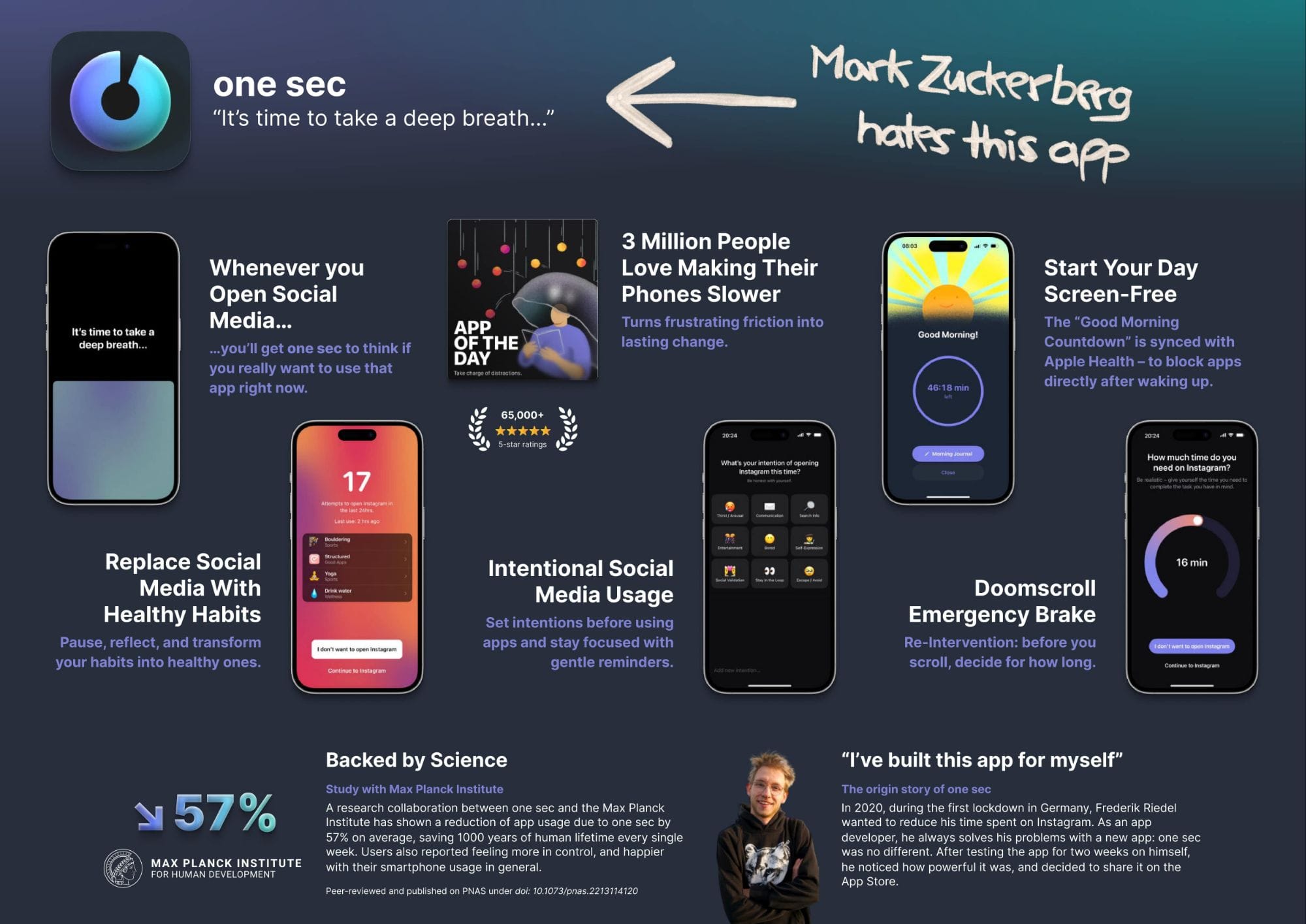
Although these strategies weren't directly tested in the study, they're practical ways to manage everyday distractions.
The goal isn't to disconnect completely but to create time for uninterrupted work, rather than allowing every notification to determine when you shift your attention.
What This Could Mean for Your Daily Focus
The findings may be relevant to everyday activities that require concentration, including studying, reading, writing and working.
Imagine developing an idea for an article. Everything seems to be coming together until a notification interrupts you.
After checking it, you return to your work but struggle to remember exactly what you intended to write next.
That experience can be frustrating, especially when you're working on something that requires careful thinking.
However, the study measured response speed during an attention task. It did not establish how long writers take to recover their ideas or prove that notifications always reduce productivity.
Still, the findings encourage us to think more carefully about the interruptions we allow into our working time.
What the Study Does NOT Prove
Although the findings are interesting, they should not be exaggerated.
The study does not prove that every notification causes exactly seven seconds of lost productivity.
It also does not show that notifications permanently damage the brain, reduce intelligence or automatically lead to poor academic performance.
Researchers measured attention and response speed under controlled experimental conditions. Everyday activities, such as preparing for examinations or writing reports, involve additional factors that the experiment did not measure.
The results also don't mean everyone responds to notifications in the same way. The effect may depend on how relevant an alert feels and a person's usual phone habits.
What the study does suggest is that notifications can briefly interrupt information processing, even when we don't open them.
Conclusion
Phone notifications have become part of everyday life, but their effect on concentration deserves attention.
A simple alert may appear harmless, yet it can briefly shift our attention away from something important.
While the study doesn't prove that notifications ruin productivity, it reminds us that frequent interruptions may matter just as much as the total time we spend on our phones.
The next time you're working on something important, consider silencing unnecessary notifications until you're done.
Sometimes, protecting your focus begins with deciding that every message doesn't need your immediate attention.
Suggested Post: one sec Review: How This App Helps You Reduce Phone Distractions, Stay Focused, and Overcome Social Media Addiction.